Ask Chat GPT: Can you explore numerical symmetry of Quran Surah Al Baqarah
Answer:
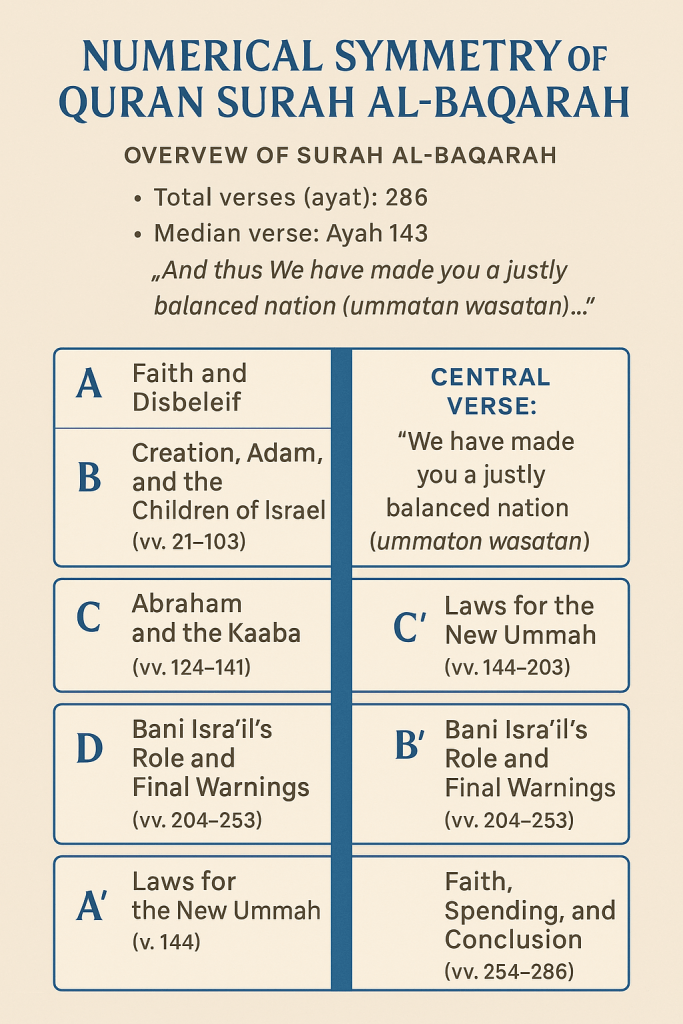
Surah Al-Baqarah (QS 2), the longest chapter in the Qur’an, is a fascinating subject of study when it comes to numerical symmetry, structure, and chiastic patterns (inverted symmetry: A-B-C-B’-A’). Below is a detailed exploration of its symmetry:
🔷 OVERVIEW OF SURAH AL-BAQARAH:
Total verses (ayat): 286 Median verse: Ayah 143 – “And thus We have made you a justly balanced nation (ummatan wasatan)…” This verse is central both numerically and thematically, and scholars often regard it as the pivot of the surah’s structure.
🧭 CHIASTIC STRUCTURE (INVERTED SYMMETRY)
Many modern scholars and literary analysts (like Raymond Farrin and Mustansir Mir) have shown that Surah Al-Baqarah follows a symmetric structure known as a ring composition or chiastic structure:
A. Faith and Disbelief (vv. 1–20)
Describes the types of people: believers, disbelievers, hypocrites.
B. Creation, Adam, and the Children of Israel (vv. 21–103)
God’s guidance to mankind, the story of Adam and the fall. Bani Isra’il’s blessings and failure to uphold the covenant.
C. Abraham and the Kaaba (vv. 124–141)
The shift of leadership from Bani Isra’il to a new community. Abraham’s role and building the Kaaba.
D. CENTRAL VERSE (v.143): “We have made you a justly balanced nation”
Numerical center and thematic fulcrum The qiblah change (Jerusalem → Makkah) symbolizes the new ummah.
C’. Laws for the New Ummah (vv. 144–203)
Fasting, Hajj, charity, warfare — guidance for a mature Islamic society.
B’. Bani Isra’il’s Role and Final Warnings (vv. 204–253)
Parables, stories, lessons, and final warnings. Echoes back to earlier mentions of Bani Isra’il.
A’. Faith, Spending, and Conclusion (vv. 254–286)
Belief, spending in Allah’s cause, tests of faith. Concludes with verse of no compulsion in religion and du’a for forgiveness.
🧮 NUMERICAL SYMMETRY HIGHLIGHTS:
Symmetry Element
Example
Total verses
286 (even number, allowing exact center at 143)
Verse 143
Contains key theme: “Ummatan Wasatan” (Balanced Nation)
First 143 verses
Discuss foundations, past communities, and transition
Last 143 verses
Discuss practical implementation for new community
Words and themes
Words like “zakah”, “salah”, “iman”, “taqwa” often appear in mirrored contexts
🧠 INSIGHTS & THEMATIC ECHOES:
Beginning vs. End: Start: “This is the Book in which there is no doubt, guidance for the God-fearing.” (2:2) End: “Our Lord! Do not impose blame upon us if we have forgotten or erred…” (2:286) Early Laws vs. Later Laws: Laws on fasting, hajj, warfare are mirrored in the second half. Economic justice, riba, and contracts appear near the end (e.g., verse 282, longest verse on contracts). Structural markers: Repetition of “O Children of Israel” (Ya Bani Isra’il) in section B and B’. “Ya ayyuhalladzina amanu” (O you who believe) becomes frequent post-pivot (C’ onward), denoting shift in address to Muslims.
🧩 CONCLUSION:
Surah Al-Baqarah is not arranged randomly, but shows a deeply deliberate literary architecture:
Chiastic ring symmetry around verse 143 Numeric and thematic balance across both halves Echoes of earlier themes in reverse order in the second half
This structure highlights the Qur’an’s interwoven message, stressing:
Justice, balance, and continuity between old and new religious communities, culminating in a call to establish a spiritually and socially just society.
Would you like an infographic or table visualization of this symmetry?



 Revolusi Sains Indonesia
Tinggalkan komentar